

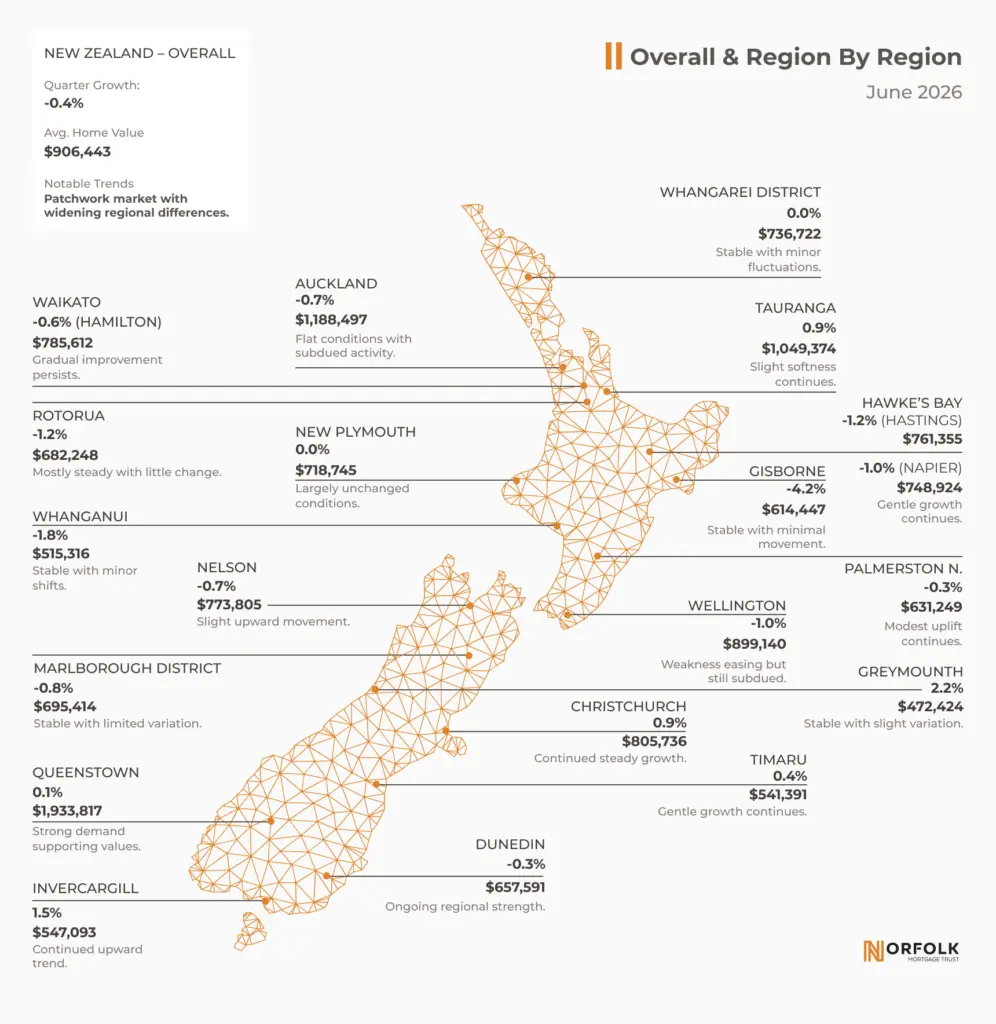
After two quarters of modest gains, New Zealand’s property market reversed course in the three months to the end of June. National home values slipped 0.4%, leaving the average home worth $906,443 – virtually unchanged from where the year began, and 14.8% below the market’s 2022 peak.
But the headline number only tells part of the story.
Across the country, buyers are still active, properties are still changing hands, and first-home buyers remain an important part of the market. What’s missing isn’t demand – it’s urgency. Buyers have more choice, they’re taking longer to make decisions, and they’re waiting until they find the right property before committing.
It’s a market that’s moving thoughtfully rather than quickly.
One Market, Many Different Stories
The regional divide we highlighted last month has become even more pronounced.
Canterbury and Southland continue to outperform, supported by strong local economies, relative affordability and balanced supply and demand. Christchurch recorded another solid quarterly increase of 0.9%, while Southland led the country with average values rising 1.0%.
Meanwhile, Auckland (-0.7%) and Wellington (-1.0%) remain subdued, with higher housing supply, softer economic conditions and more cautious buyer sentiment continuing to weigh on prices.
Across much of the country, first-home buyers remain the most active group in the market. Elevated housing stock is giving purchasers more options and more negotiating power, allowing them to take their time rather than feeling pressured to act.
Rather than one national property story, New Zealand continues to be a collection of regional markets, each responding to its own economic conditions.
The Move No One Was Surprised By
The Reserve Bank’s decision to raise the Official Cash Rate on 8 July was widely anticipated. Moving up from 2.25%, with further increases signalled ahead, the Bank’s aim is to keep inflation contained as economic recovery gains traction – and to prevent rising costs from becoming embedded once businesses regain the ability to pass them on.
For property buyers already treading carefully, the announcement adds another layer of consideration. With a general election approaching, global uncertainty persisting and mortgage affordability tightening further, the conditions keeping buyer confidence subdued show little sign of resolving quickly. The second half of 2026 is shaping up to be a period of significant milestones. For the property market, much depends on how they land.
The Other Side of the Ledger
For property owners hoping the second half of 2026 brings a value recovery, rising interest rates represent another headwind. Affordability tightens. Buyer hesitancy deepens. Recovery timelines extend.
For investors whose returns are generated through lending against property – rather than through property values rising – the relationship with that environment looks different. Norfolk Mortgage Trust’s income comes from interest paid by borrowers, not from the appreciation of property assets. That’s a structurally different position in the market, and one that doesn’t rely on values climbing to deliver returns.
That distinction matters more in an environment like this one, where capital growth is not reliably available and where the backdrop continues to shift.
The Long Game
Norfolk Mortgage Trust has been providing property-backed investment since 2006 – through falling rates and rising ones, through market peaks and corrections, through the GFC, the Christchurch earthquakes, the COVID-era surge and the correction that followed it.
The approach has remained consistent throughout: carefully selected first mortgage lending, secured against New Zealand property, with conservative loan-to-value ratios and diversification across multiple loans, borrowers and regions. First mortgage security places Norfolk at the front of the lending queue – in the event a borrower defaults, first mortgage lenders are repaid before any other creditors, providing an important layer of capital protection.
For investors, that translates to regular monthly income that doesn’t require the property market to be rising, or interest rates to be heading in any particular direction. The income is generated by the lending itself – not by what happens to property values in any given quarter.
As at 30 June 2026, Norfolk Mortgage Trust manages $65.8 million in investor funds. Investors are currently receiving a pre-tax annualised return of 6.25%, paid monthly.*
As the property market grows more regional in its behaviour and the economic backdrop continues to shift, the fundamentals of disciplined, property-backed lending remain just as relevant as they have been across Norfolk’s two decades in the market.
*The annualised pre-tax return is current as at 30 June 2026 and is subject to change without notice. Past performance is not a reliable indicator of future performance.
Learn More
If you’re looking to generate regular monthly income from property-backed investments – without the complexity of direct property ownership – Norfolk Mortgage Trust offers a disciplined, long-established approach.
To find out more, visit norfolktrust.co.nz or get in touch with our team.
Explore how Norfolk delivers consistent, property-backed income at norfolktrust.co.nz
Data Source: QV House Price Index, June 2026