

Spring traditionally brings renewed energy to New Zealand’s property market.
More homes come onto the market. More buyers start looking. Open homes get busier and sales activity begins to lift.
But this spring, more activity may not necessarily mean rising prices.
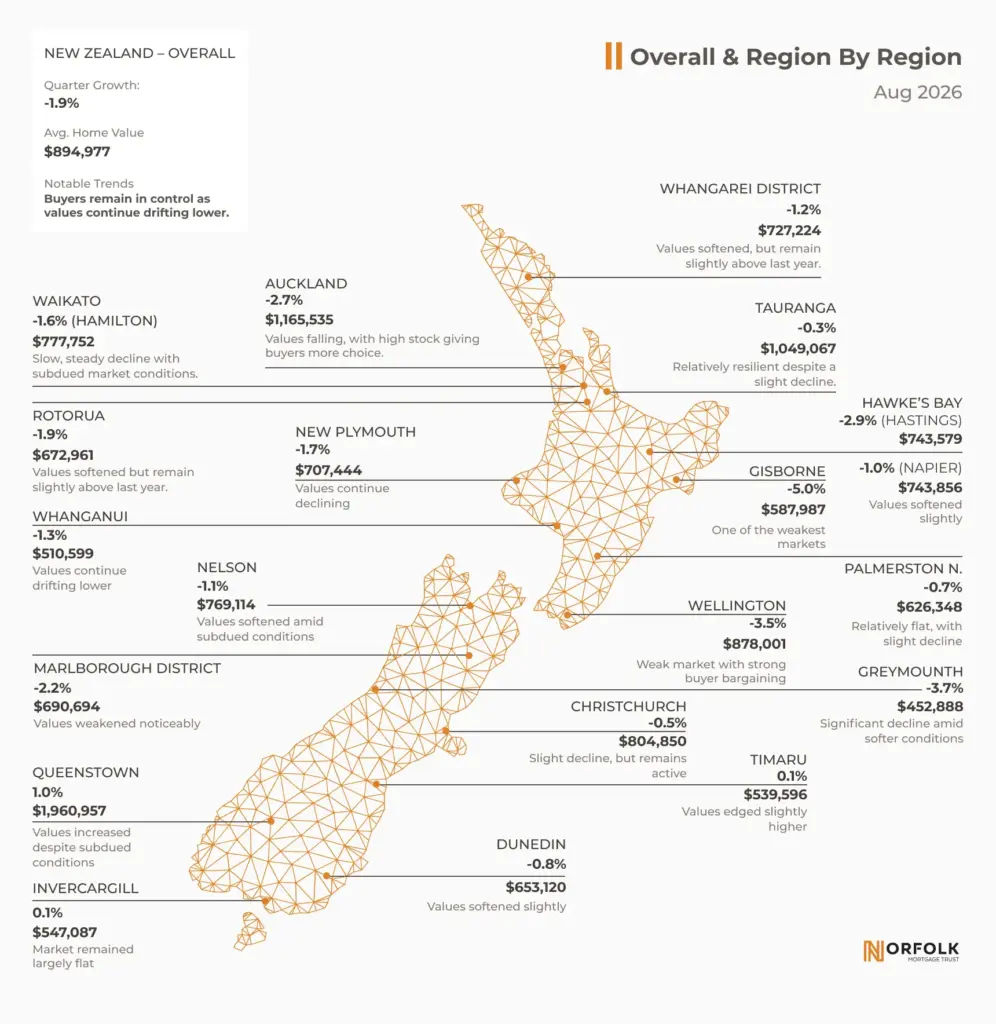
The latest QV House Price Index shows residential property values fell 1.9% nationally over the three months to the end of August – the largest quarterly decline in two years. The average New Zealand home is now worth $894,977, down 1.7% since the beginning of the year and 1.3% lower than this time last year.
Auckland values fell 2.7% over the quarter, while Wellington recorded another significant decline. Even Christchurch – one of the more resilient markets of the past year – slipped 0.5%, its first negative quarterly result in 11 months.
Yet this doesn’t look like a market in freefall.
Instead, QV describes a slow deterioration in values as buyers continue to hold the upper hand. There is plenty of property to choose from, purchasers are taking their time, negotiating hard and increasingly prepared to walk away when the numbers don’t stack up.
As we head into spring, that creates an interesting dynamic.
The property market could become busier – without necessarily becoming stronger.
When Activity and Growth Part Ways
Normally, increasing market activity is interpreted as an early sign of renewed momentum. But that relationship isn’t guaranteed.
Spring will almost certainly bring more properties to market. What remains uncertain is whether there will be enough additional demand to absorb them.
In Auckland, for example, QV reports that stock levels remain high, with a significant number of new-build townhouses also available. That gives purchasers choice and, importantly, negotiating power.
Similar conditions are evident elsewhere. First-home buyers remain active in many regions, but investors and existing homeowners looking to move are generally more cautious.
There are exceptions. Queenstown recorded 1% quarterly growth, while some parts of Waikato and the lower South Island continue to show greater resilience.
But the national picture remains subdued. For sellers, that means simply putting a property on the market this spring may not be enough. Price, location, property quality and buyer demand all matter.
A Market That Rewards Selectivity
When markets are rising strongly, momentum can sometimes disguise an average decision.
When they aren’t, the fundamentals become much more important.
What is the asset worth today? What could affect its value? Where is demand coming from? How much margin is there if conditions change?
These are the same questions that sit behind every lending decision Norfolk Mortgage Trust makes. Rather than owning property directly, Norfolk lends to borrowers – each loan secured by a first registered mortgage over New Zealand property. Investor income comes from the interest those borrowers pay, not from what happens to property values.
That structure means the rigour applied to each loan matters enormously. Is the underlying security genuinely sound? Can the borrower meet their interest payments? Is there a clear pathway to repayment? Conservative loan-to-value ratios ensure there is a meaningful buffer between the amount lent and the property’s assessed value.
Being selective about which loans make it into the portfolio is part of the discipline.
Why the Margin Matters
In a softer property market, the relationship between the amount being lent and the value of the property securing that loan becomes particularly important.
A conservative loan-to-value ratio creates a margin between the loan and the assessed value of the underlying property.
It’s a straightforward principle, but an important one.
Rather than relying on future property growth to strengthen a lending position, Norfolk assesses the loan based on the property value and circumstances at the time the lending decision is made.
Spreading the portfolio across different borrowers, loan types, property categories and regions adds another layer of discipline – no single asset or location carries the whole weight of the portfolio.
It’s an approach built to hold up across different points in the property cycle, not just the favourable ones.
What Will Spring Bring?
The next few months will tell us more.
More listings and greater activity could help bring buyers and sellers closer together. Equally, if buyer confidence remains subdued and available stock continues to build, vendors may simply find themselves competing harder for cautious purchasers.
Either way, the current market offers a useful reminder.
Activity and momentum aren’t the same thing.
And when markets aren’t providing an easy tailwind, disciplined decisions matter more.
That’s true whether spring brings renewed confidence or simply more competition between cautious sellers. For Norfolk Mortgage Trust, the approach doesn’t change with the season: assess each lending opportunity carefully, maintain disciplined lending standards, diversify the portfolio, and generate investor returns from the interest borrowers pay on those loans – as it has done through very different property cycles over the past two decades.
Norfolk’s current annualised pre-tax return for the month ending 31st August 2026 is 6.25% p.a., with an income distribution paid monthly.*
Markets will keep changing.
The principles behind good lending don’t need to.
Learn More
If you’re looking for regular monthly income from a diversified portfolio of loans secured by first registered mortgages over New Zealand property, Norfolk Mortgage Trust offers a long-established investment approach focused on disciplined lending, diversification and consistency through changing market conditions.
To learn more, download our Product Disclosure Statement or Investment Guide, visit norfolktrust.co.nz.
*The current annualised pre-tax return of 6.25% is subject to change without notice. Past performance is not a reliable indicator of future performance.
Data Source: QV House Price Index, Aug 2026