

The New Zealand property market has become quieter.
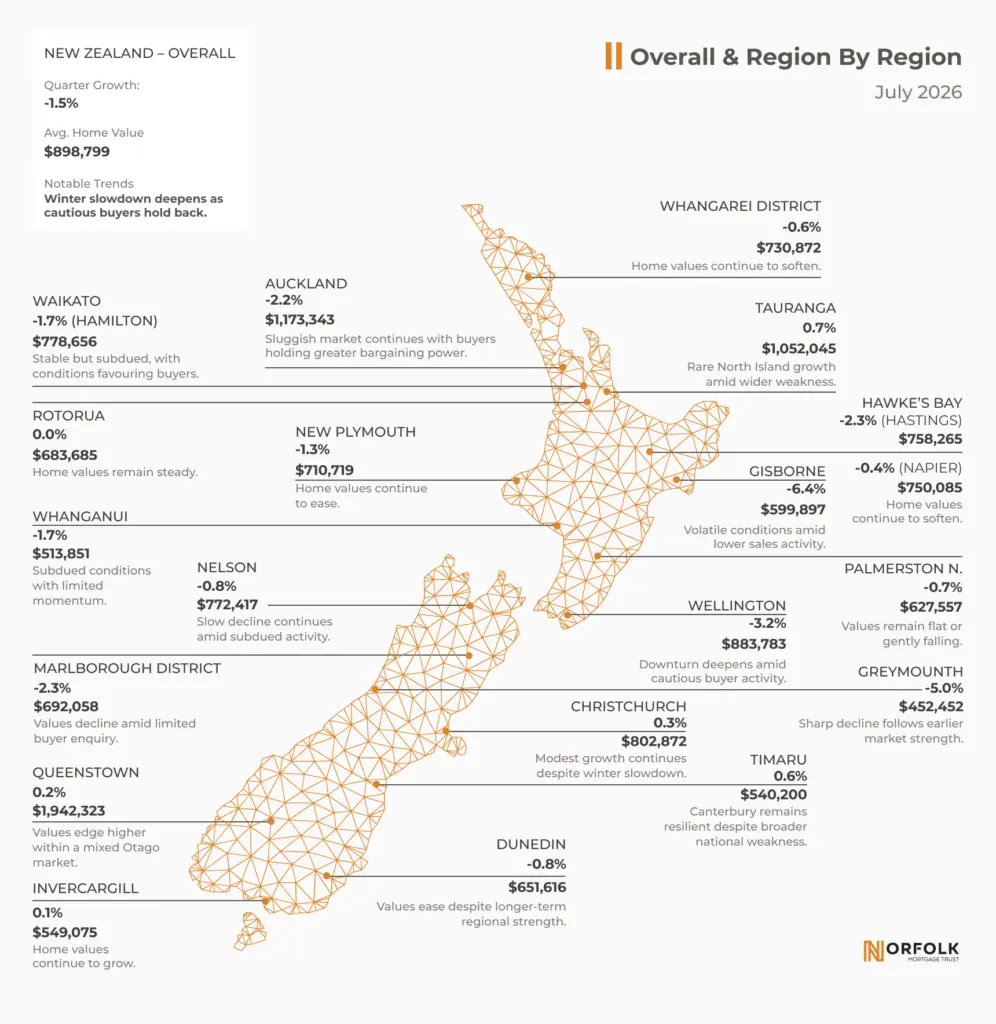
After losing momentum in June, the latest QV House Price Index shows average home values fell 1.5% nationally over the 3 months to the end of July. The average New Zealand home is now worth $898,799 – down 1.3% since the beginning of the year and 1.2% lower than this time last year.
Importantly, this isn’t another sharp property correction. It’s a subdued market becoming quieter still, with buyers taking their time and sellers adjusting to a more cautious environment.
Higher borrowing costs, economic uncertainty and the approaching general election have all contributed to a market where buyers have little urgency. With more properties available and plenty of choice, patience increasingly belongs to the buyer.
For investors, however, today’s market raises a different question.
If capital growth is becoming harder to predict, should your investment strategy rely on predicting it at all?
Property Is Increasingly a Local Story
One of the biggest shifts over the past year is that New Zealand is no longer behaving like a single property market.
Instead, regional performance is becoming increasingly varied.
Auckland and Wellington have continued to soften, with buyers benefiting from greater choice and stronger negotiating power. Meanwhile, parts of Canterbury, Otago and Tauranga have shown greater resilience, supported by local economic conditions, affordability and ongoing demand.
The message isn’t simply that one part of the country is outperforming another. It’s that local fundamentals now matter more than broad national trends. Employment, housing supply, affordability and buyer demand are increasingly determining how individual markets perform.
For anyone relying on capital growth, that makes the outlook more difficult to predict.
There will still be opportunities. Some properties will continue to perform well. But broad-based growth across the country can no longer be taken for granted.
A Different Way to Invest in Property
This is where investing through Norfolk Mortgage Trust differs from owning an investment property directly.
Rather than purchasing property with the expectation it will increase in value over time, Norfolk provides loans to borrowers secured by first registered mortgages over New Zealand property.
Investor income is generated from the interest borrowers pay on those loans – not from rising property prices.
That distinction becomes particularly relevant in markets like today’s. While the underlying property remains an important part of the security supporting every loan, investor returns are not dependent on predicting when or where property values will rise.
Instead, Norfolk’s focus is on disciplined lending and careful risk management.
Every loan is carefully assessed, with particular emphasis placed on the quality of the property security, conservative loan-to-value ratios and a clearly defined exit strategy for repaying the loan. Borrowers are also assessed on their ability to meet their ongoing interest obligations.
The portfolio is further diversified across multiple loans, borrowers, property types and regions, reducing reliance on the performance of any single property or location.
Most loans are also relatively short term – typically around 12 months, and generally between six months and three years. Rather than having capital tied up in a single long-term property investment, funds are continually repaid and reinvested as loans mature.
Together, these principles form a conservative investment approach built around disciplined lending, diversification and regular monthly income.
Consistency Through Changing Markets
This year marks 20 years since Norfolk Mortgage Trust began operating.
Over those two decades, New Zealand property has experienced extraordinary growth, significant corrections, historically low interest rates, rapidly rising interest rates, the Global Financial Crisis, the Christchurch earthquakes, a global pandemic and the housing boom and correction that followed.
Through each of those changing market conditions, Norfolk’s investment philosophy has remained remarkably consistent.
The focus has always been on conservative 1st mortgage lending, disciplined credit assessment and generating regular monthly income from a diversified portfolio.
Today, Norfolk Mortgage Trust manages $70.5 million on behalf of New Zealand investors.
Over the past five years, investors have received an average pre-tax return of 7.15% per annum, with income paid monthly.* The current annualised pre-tax return, as at 31 July 2026, is 6.25%.*
20-years of changing markets remind us that no one can consistently predict what property prices will do next.
Choosing an investment approach that isn’t built around having to make that prediction may be the more enduring strategy.
Learn More
If you’re looking for regular monthly income from a diversified portfolio of loans secured by first registered mortgages over New Zealand property, Norfolk Mortgage Trust offers a long-established investment approach focused on disciplined lending, diversification and consistency through changing market conditions.
To learn more or download our Investment Guide, visit norfolktrust.co.nz
The five-year average return of 7.15% per annum and the current annualised pre-tax return of 6.25% are current as at 31 July 2026. Returns are calculated monthly. Past performance is not a reliable indicator of future performance.
Data Source: QV House Price Index, July 2026