

For much of the past decade, New Zealand’s property market moved broadly in one direction. When Auckland surged, much of the country followed. When interest rates rose and values softened, the effects were felt almost everywhere.
The latest QV House Price Index suggests those days may be behind us.
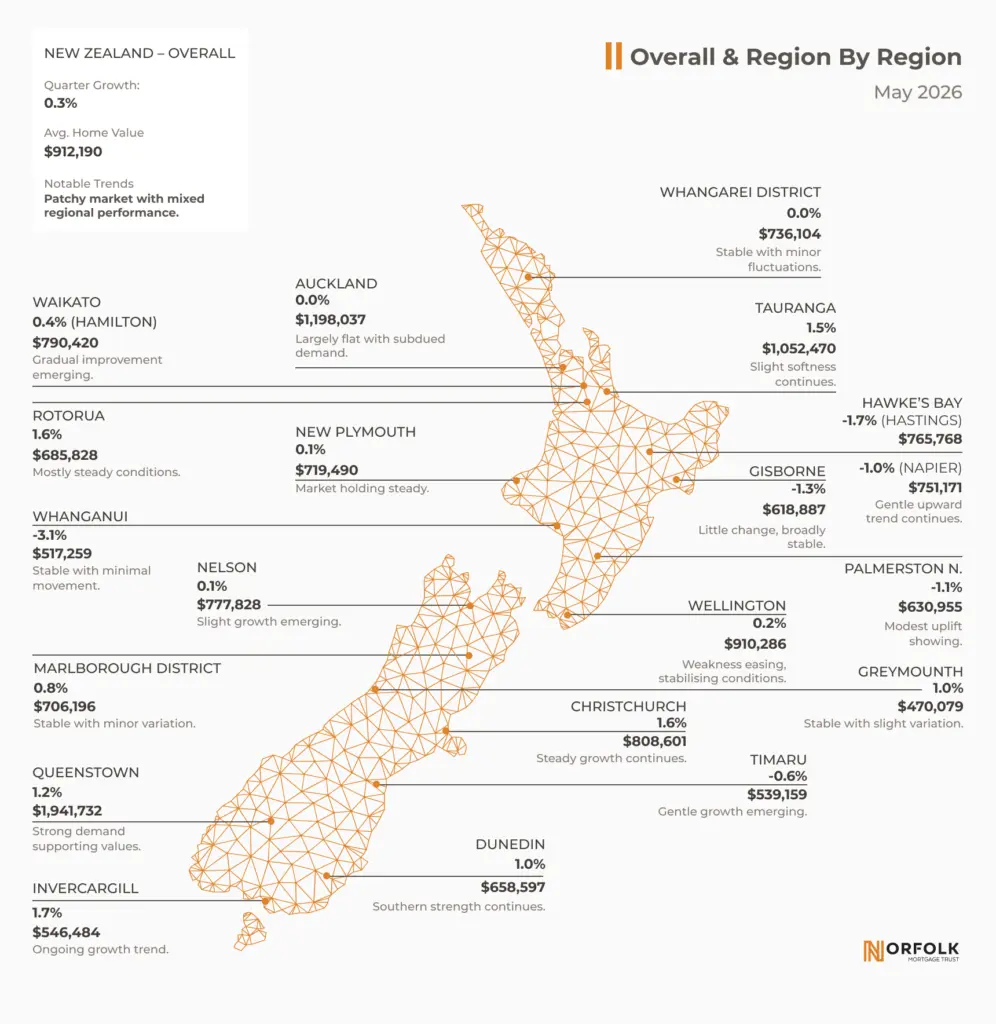
Nationally, home values remain relatively stable, rising just 0.3% over the past quarter. But beneath those modest headline numbers, a different story is emerging: regional markets are moving to their own rhythm.
QV describes the current environment as a “patchwork” market — some centres gaining momentum while others continue to tread water.
For investors, that’s an important shift. When markets stop moving together, where and how capital is deployed matters far more.
One Country, Very Different Outcomes
The latest QV data highlights a widening divide between regions.
Several South Island centres continued to perform strongly over the quarter:
- Invercargill: +1.7%
- Christchurch: +1.6%
- Queenstown: +1.2%
- Dunedin: +1.0%
Christchurch has now fully recovered the value declines of the market correction and sits just above its previous peak.
Meanwhile, many North Island centres remained subdued:
- Hamilton: +0.4%
- Wellington: +0.2%
- Auckland: 0.0%, and still well below its previous high
None of these markets are seeing dramatic swings. But the differences are becoming hard to ignore.
The result is a property market that can no longer be understood through a single national headline. What’s happening in Christchurch looks very different to Wellington. Queenstown is different again.
For investors, broad assumptions about “the property market” are becoming less useful than understanding the specific drivers behind individual regions.
Why Fragmentation Changes the Investment Equation
In a rapidly rising market, diversification can feel less important. When values climb almost everywhere, momentum masks differences in performance and risk.
Today’s environment is different. As regional outcomes diverge, investment results depend more on selection, structure and risk management. In other words, the market itself is doing less of the work.
That’s particularly relevant for investors seeking reliable income rather than speculative growth. When markets fragment:
- Regional risk matters more
- Diversification becomes more valuable
- The quality and consistency of income becomes easier to judge
- Investment structure plays a larger role in outcomes
Rather than relying on a broad market trend, investors need confidence in the quality of the underlying investment itself.
Investing in a Market That Doesn’t Move Together
The latest QV data reinforces an important reality about New Zealand property in 2026. The market hasn’t stalled — it’s become more selective.
Different regions are producing different outcomes, and investors can no longer rely on national trends alone. In that environment, diversification, structure and consistency become genuinely valuable. Investors need approaches that aren’t dependent on a single region, a single property, or a particular phase of the market cycle.
That’s where Norfolk Mortgage Trust is positioned.
Where Norfolk Mortgage Trust Fits
Norfolk Mortgage Trust has provided property-backed investment since 2006, and is structured for exactly this kind of environment.
Rather than relying on property values rising across the country, returns are generated through carefully selected first mortgage lending, secured against real property assets. That approach provides diversification across multiple loans, borrowers and regions — reducing reliance on the fortunes of any single property market.
The fundamentals remain unchanged:
- First mortgage security
- Conservative loan-to-value ratios
- Disciplined lending practices
- A focus on capital preservation and regular income
As regional markets move in different directions, those principles matter more, not less.
As at May 2026, Norfolk Mortgage Trust manages more than $60 million in funds, and investors are currently receiving a pre-tax annualised return of 6.25%, paid monthly.
While the market may continue to look different from one region to the next, Norfolk’s focus remains the same: consistent, property-backed income through disciplined lending and prudent risk management.
Learn More
If you’re looking to generate regular monthly income from property-backed investments – without the complexity of direct property ownership — Norfolk Mortgage Trust offers a disciplined, long-established approach.
To find out more, visit norfolktrust.co.nz or get in touch with our team.
Explore how Norfolk delivers consistent, property-backed income at norfolktrust.co.nz
Data Source: QV House Price Index, May 2026