
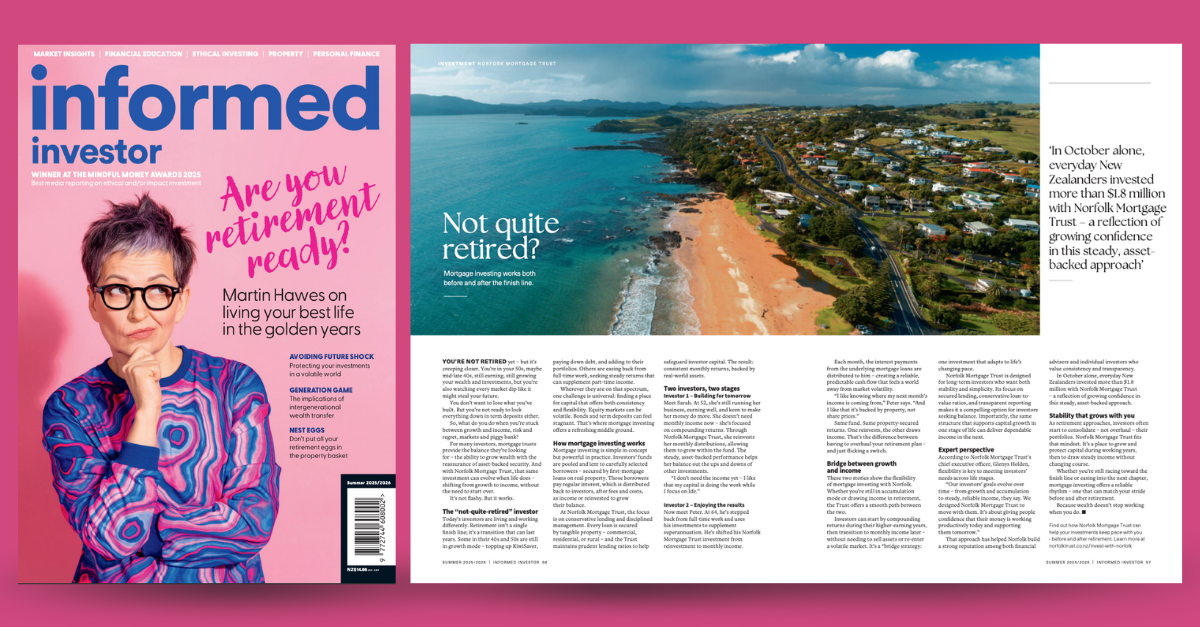
Retirement isn’t a finish line anymore. For many Kiwis in their 40s, 50s and early 60s, it’s a transition — one that can feel financially messy.
You’re still earning. Still growing your wealth.
But you’re also paying closer attention to risk.
Too much volatility feels uncomfortable.
Too much money in term deposits feels limiting.
That tension is exactly why mortgage trust investing is gaining attention — and why Norfolk Mortgage Trust was recently featured in Informed Investor, exploring how mortgage trusts can support investors both before and after the traditional retirement “finish line”.
More than $1.8 million was invested by everyday Kiwis with Norfolk in October ‘25 alone – a reflection of the growing demand for consistent, asset-backed returns during uncertain market conditions.
Why the “Not Quite Retired” Investor Is Growing
Many investors now spend years in the space between full-time work and full retirement. You might be:
- Building or consolidating your investment portfolio
- Reducing mortgage or personal debt
- Increasing KiwiSaver contributions
- Moving to part-time or flexible work
- Planning for a smooth, stable transition into retirement income
The common challenge?
Where to place capital so it remains productive, without exposing you to unnecessary risk or locking it away too early.
This is where mortgage trust investing fills a gap that traditional markets and term deposits can’t always solve.
How Mortgage Trust Investing Works – And Why It Suits This Life Stage
Mortgage trusts pool investor funds and lend them to carefully assessed borrowers, secured against real property – watch our video here. Those borrowers pay interest, which is then distributed to investors – either as income or reinvested to grow their balance.
At Norfolk Mortgage Trust, this approach is built on:
- Conservative loan-to-value ratios
- First-mortgage security over tangible property
- Disciplined borrower assessment
- Transparent reporting
- Consistent monthly returns
This combination provides two things many “not quite retired” investors want:
predictability and progress.

Two Investors. Two Life Stages. One Investment.
The article tells the story of two investors who use the same fund in completely different ways
1. Sarah – 52, Still Building for Tomorrow
Sarah’s running her business, earning well, and focused on compounding returns, not income. She reinvests her monthly distributions through Norfolk, letting her capital grow inside the fund.
“I don’t need the income yet — I like that my capital is doing the work while I focus on life.”
2. Peter – 64, Enjoying the Results
Peter has stepped back from full-time work and uses his investments to supplement his income. He switches his Norfolk investment from reinvestment to monthly income mode.
“I like knowing where my next month’s income is coming from. And I like that it’s backed by property, not share prices.”
One fund. Two outcomes.
No selling, no switching, no resetting your entire plan.
A Smooth Bridge Between Growth and Income
This is the core idea of Norfolk Mortgage Trust – and why it’s especially relevant to investors approaching retirement:
- When you’re in your higher-earning years → reinvest and grow your balance.
- When your income needs change → switch to monthly income, without selling units or re-entering a volatile market.
Your investment evolves with your life. Not the other way around.
It’s stability that grows with you.
Why More New Zealanders Are Turning to Mortgage Trusts
Across both advisers and individual investors, mortgage trusts are increasingly seen as a middle ground between market volatility and low-return cash products.
You get:
- Asset-backed security
- Consistent monthly returns
- A clear, transparent structure
- Flexibility across life stages
- A smoother emotional experience — fewer market shocks, more control
As Norfolk’s CEO Glenys Holden put it in the article:
“Our investors’ goals evolve over time — from growth and accumulation to steady, reliable income. We designed Norfolk Mortgage Trust to move with them.”
Mortgage investing can play a valuable role in both the growth and income phases of your financial life.
Read the full article:
Not Quite Retired? Why Mortgage Investing Works Before and After the Finish Line. Available in the December 2025 issue of Informed Investor.
Learn more and see how Norfolk can work for you.